
You Can't Do the Same Thing for 200 Years

Disclaimer: The views and opinions expressed in the contents below are those of the speaker and do not necessarily reflect the views of the Royal Business Bank (the “Bank”) or any entity related to “the Bank”.
Introduction
What if the biggest threat to community banks isn't a competitor, a recession, or regulation?
Gary Fan never set out for a career in banking but decided to stay the moment he sensed the scale of change coming. Now, as the COO of Royal Business Bank, he's making an unconventional bet: the way to win isn't to digitize the old banking model, but to rethink how a bank operates from scratch.
In this candid interview, Gary shares why he believes most banking "modernization" is still a decade behind other industries, how AI gives smaller banks an unfair advantage against the money-center giants, and why relationships alone won't be enough to hold onto the next generation of customers. All of it in preparation for what he's convinced is coming: the industry's own "Blockbuster-Netflix moment".
“Banks that say "we're going to focus just on relationships" and avoid technology are missing the bigger trend.”
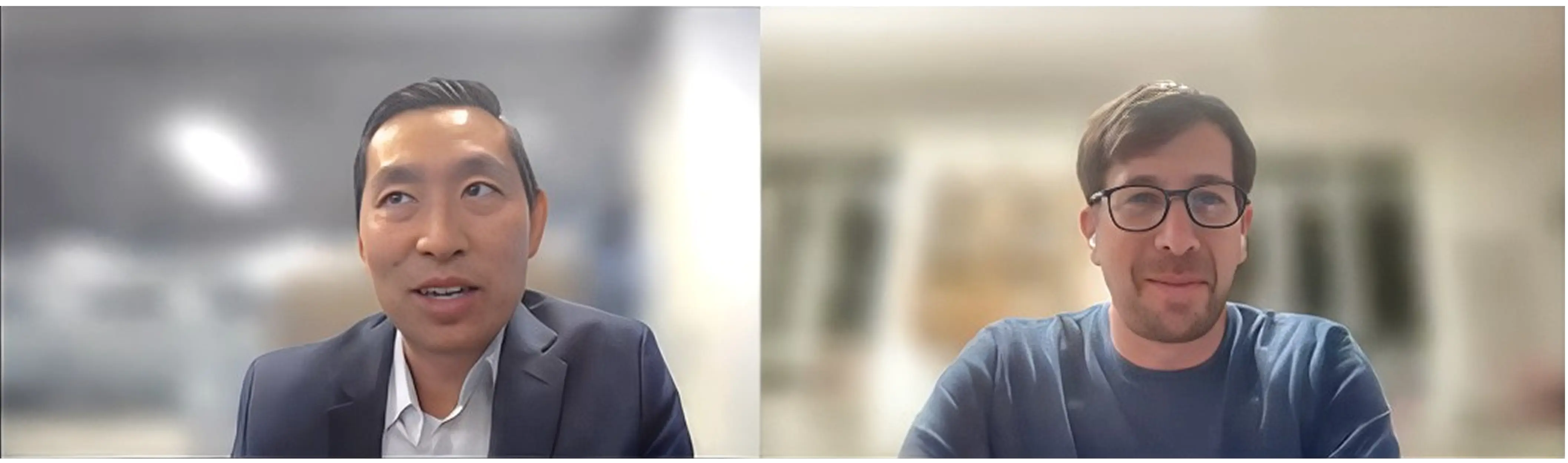
Interview
Omri: Gary, how did you land in banking?
Gary: Funny enough, but I didn't choose community banking, I sort of fell into it, like many others. But once I got here, I could sense there were some massive changes and opportunities coming, and that's what kept me here. I don't think we're through the biggest changes yet.
Omri: Big changes?
I think we'll see a massive technological disruption in this space, along with a shift in the demographics of our existing customer base. Most of the long-term customers the banks have grown up with are nearing the end of their professional lives, and their assets and companies are transitioning. Combine that with the great wealth transfer and fintechs entering the space, and banking is at a giant inflection point.
Omri: You’ve seen banking also from the fintech side. How do fintechs challenge banks?
Gary: The pace of movement and change is probably the biggest thing. In banking we have many stakeholders. Our investors, the government, the FDIC, other regulatory agencies, employees. It's harder to move as quickly as you could if you weren't a regulated entity.
Moving fast has both risks and rewards, and the same is true for a bank. If you can't move as fast as fintech companies, you miss out on opportunities. But there's also risk mitigation built in, so you're not running into a brick wall the way we've seen some companies do.
Omri: As the COO of the bank, how do you make sure you move fast but responsibly?
Gary: My view of this type of role is that you're really the execution arm for the company, running some of the business units and a number of support functions. I'm very interested in this industry and in helping companies digitize themselves. Transitioning a legacy business model into something scalable, with a different cost structure and a different way of gathering new business, is challenging. I think that's where the key opportunities will be in the future.
Omri: Some would say banks have been digitizing for the past two or three decades. But I suspect you're talking about a different kind of modernization?
Gary: There's definitely been technological progress in our industry, but at a pace that's much slower than other industries. Most of the progress has been things other industries did a decade ago. Banking only recently started doing online account opening, and some banks still don't offer it. Retail did that decades ago. I think part of the reason is the moat created by how we're regulated and how our business model works, and part of it comes down to leadership decisions and the demographics of the people who run banks.
The transformation I'm thinking about starts from scratch. Can we rethink how a bank operates? Is there a different operating model that makes sense, from a personnel standpoint and a technology standpoint? Which vendors are best suited to help us figure out what's best-in-class, rather than buying 80% of our technology and services from one company? I'm interested in what that could look like.
There are different ways to run this business, and as an industry we're still at the very beginning of understanding what's possible.
“The transformation I'm thinking about starts from scratch. Can we rethink how a bank operates? Is there a different operating model that makes sense?”
Omri: Some people say: "With AI, we can now build a lot of things ourselves." What's your reaction to that?
Gary: Even if you don't believe them, you should try it. There are banks that have taken the initiative and started projects like this, and I don't think you can argue there's no value there. Even outside of banking, individuals use large language models to improve their personal lives. Their ideas can be applied to a larger corporation and we should figure out whether that works for us.
I do think this is one of those transformational technologies, and the people who move first have an unfair advantage if they can execute. If you have your head in the sand as an institution and you're ignoring this whole space, you'll be at a severe disadvantage. AI takes the manual paperwork off our plate so we can focus on what matters. For a smaller bank like ours, if we can figure this out, we'll be able to scale much faster and have a very different cost structure than everyone else, which gives us advantages we can leverage elsewhere. So overall, it feels like a genuinely positive technology with significant, material impact on this industry going forward.
Omri: You're describing a first-mover advantage, but over time how do you keep that edge?
Gary: In our industry, a lot of the business is commoditized. There are thousands of banks and credit unions competing in the consumer market. Everyone talks about relationships, and that is a material value add. But if you take the base product, like a loan, there are thousands of companies offering the same thing. So you have to find ways to differentiate. Otherwise you're just playing the scale game against the giant money-center banks, and they have the pricing power to squash your margins.
Using tools like AI to gain a first-mover advantage, or to create a differentiated value proposition, is really important. As a smaller bank, there are places where you can outcompete larger institutions. You have to specialize in what you want to do.
“There's no industry where you can do the same thing for two hundred years and expect to stay in the same position. Banking is at a stage where if you're not evolving, you'll eventually get swallowed up.”
Omri: Community bankers pride themselves on relationships, and some worry that adopting new technology to become more efficient will actually hurt that differentiator. What's your take?
Gary: People want to speak with people, especially when it comes to big decisions in life. So some form of human relationship will always exist. But banks that say "we're going to focus just on relationships" and avoid technology are missing the bigger trend. If you create limitations and someone else offers what you don't, your clients will eventually move. Demographics matter here too. The younger generation is tomorrow's business owners, or the descendants of our current clients. They have very different expectations than their parents' or grandparents' generation. If you're not offering a great mobile or online experience, they won't come to you. The interesting part of this transition is that if you move first, and offer unique products and services, you have a real opportunity to capture more customers and grow your business than you would have a few decades ago.
Omri: Most features get copied, and most e-banking platforms end up looking pretty similar. So what can banks do to stay at the top, not just keep up?
Gary: You have to move faster. For me, that starts with the product. That's where you have room to adjust things and create a value proposition, even if it inherently adds some risk, which you then mitigate elsewhere. You end up creating different products, and I think that's what resonates with customers. The commodity lifecycle makes you have to constantly stay a few steps ahead, and that's how every industry works. There's no industry where you can do the same thing for two hundred years and expect to stay in the same position. Banking is finally at a stage where if you're not evolving, you'll eventually get swallowed up.
Omri: Making those adaptations isn't always easy. What's your advice on being a change engine within an organization, from the COO's perspective?
Gary: Some people might read this and think I'm a little crazy. But if you believe this is the right direction, I'd recommend starting small. Part of it is the risk tolerance of our industry. We're not a startup trying to revolutionize things overnight. We're trying to provide a consistent, reliable earnings stream to our investors and scale the bank safely and soundly. You have to build from that foundation, even if your aspirations are bigger.
Earnings are the key driver for all of us, so if you can prove a use case with material value, that gives you the stepping stone to larger projects. I made a mistake early in my career trying to convince everyone we needed to break everything and rebuild from scratch. People come around once the results are consistent and sustainable.
It's important to allow some flexibility, and there are ways to accelerate that process. Once those conditions are in place, you can really start making moves. I feel like we're getting close to the Uber-taxi-driver moment, or the Blockbuster-Netflix moment, where our whole industry shifts very rapidly in a short amount of time. That's a great opportunity for companies that have been preparing and are ready for it, and not such a great one for companies that have refused to evolve. I do think it's coming.
Omri: Gary, thank you very much
Gary Fan - Bio
Gary Fan is the COO of RBB, a publicly traded bank with over $4 billion in assets. As COO, Gary leads enterprise-wide growth initiatives, digital transformation, product and service innovation, and residential mortgage. He is also responsible for optimizing cross-functional operations and driving continuous business model evolution to stay ahead in a rapidly changing financial landscape.
Previously, Gary served as President of Gateway Bank FSB in Oakland, CA, where he successfully led a full-scale turnaround, overseeing all retail and commercial banking units and restoring profitability. His leadership has consistently delivered measurable results across diverse financial institutions.
Gary’s career spans senior roles at global financial organizations, including CTBC Bank, where he served as Head of Strategy for North America and Head of Consumer Lending for its U.S. subsidiary. His expertise includes fintech integration, strategic partnerships, market expansion, long-range planning, and organizational restructuring.
With P&L responsibility over billion-dollar lending portfolios, Gary has led high-performing teams across Sales, Marketing, Retail and Commercial Banking, Mortgage, Small Business Lending, Wealth Management, Operations, Credit Administration, Finance, IT & Security, HR, Legal, PMO, and Real Estate. His cross-industry experience includes Banking, Fintech, E-Commerce, Manufacturing, and Supply Chain & Logistics.
Gary holds a bachelor’s degree from the University of California, Berkeley, and is a graduate of the Stonier Graduate School of Banking at The Wharton School.


%201%20(2).webp)

.webp)
.webp)




.webp)

.webp)

.webp)


.webp)


Knowledge is power